

On Friday, November 13th PAN representatives attended the BC Centre for Excellence in HIV/AIDS’s (BC-CfE) 2026 Fall Update on Substance Use Disorder. To see the full program, please click here. Video presentations of the event will be available in a few weeks on this page.
The second session of the day was very informative; featuring insights from the BC-CfE Hope to Health Research and Innovation Centre.
Meeting People Where They Are
presented by Kate Salters (Principle Investigator of the SISCO and SHAPE studies)
Dr. Salters started this session by reminding everyone that Harm Reduction is not controversial. Harm reduction is based on a pragmatic, non-judgmental approach to the provision of health services that respects the dignity of people who use drugs and values their human rights (See the Canadian Centre on Substance Use’s report Harm Reduction: What’s in a Name?). She also laid out the present-day harm reduction service models in BC (see PIVOT Legal’s SCS and OPS in Canada Map) and gave attendees an overview of the differences between Supervised Consumption Sites (SCSs) and Overdose Prevention Sites (OPSs).
What’s the difference between a supervised consumption site and an overdose prevention site?
| Supervised Consumption Sites (SCS) | Overdose Prevention Sites (OPS) | |
| Witnessed drug consumption and overdose response | yes | yes |
| Provision of sterile harm reduction supplies | yes | yes |
| Referrals/connections to treatment and health services | yes | yes |
| Federal exemption required (Section 56.1 CDSA via Health Canada) | yes | x |
| Provincial Ministerial Order/Emergency Health Exemption | x | yes |
| Rapid setup/nimble deployment | x | yes |
| Long-term, formal clinical facility structure | yes | x |
Next, Dr. Salters presented 4 challenges harm reduction is facing, and the responses to them.
Challenge 1: Needing to adapt to a volatile crisis
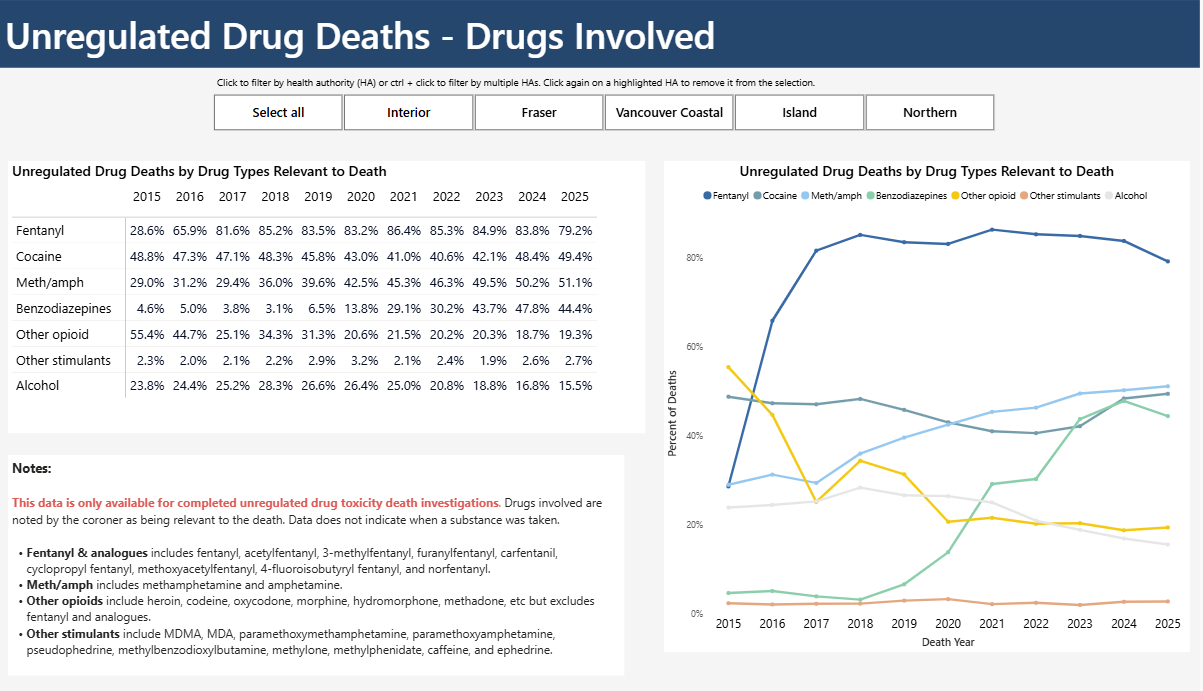
From the BC coroners service – statistical report drugs relevant to death (image below) and drugs detected are constantly shifting.
The Response: enhanced scale up of:
- drug testing (test strips or mass spectrometry)
- take home naloxone and;
- drug alerts (by phone or printed in SCSs)
Challenge 2: Adapting services to shifting consumption patterns
More people are smoking versus injecting their drugs for many reasons (as examples: this itself is a harm reduction strategy to reduce one’s risk of exposure to bloodborne infections, or because of difficult veinous access). Dr. Salters shared that inhaled drugs are now accounting for 64% of drug deaths, while injecting accounts for 8%. Therefore, having SCSs or OPSs that are only for injecting can create barriers to safety and wellbeing for folks who inhale their drugs.
Response: Opening and expanding supervised inhalation sites
Hope to Health also shared that the rate of clinic visits (for any purpose!) doubled with the opening of their supervised inhalation sites (this observation is forthcoming in their July to September 2026 Hope to Health SCS Report)
Challenge 3: the geography of access
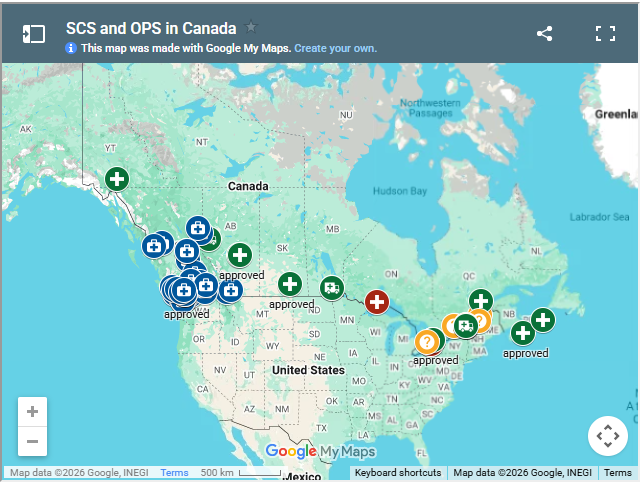
Evident from PIVOT Legal Society’s map, most SCSs and OPSs are operating in larger, urban cities.
Response: Establishing a National Overdose Response System
The National Overdose Reponse System (NORS) is a full service, virtual safer supervised consumption and peer wellness program.
- NORS safer supervised consumption hotline: 1-888-688-6677
- NORS peer wellness hotline: 1-844-795-6677
Challenge 4: Combating the “Harm Reduction vs. Treatment” argument
Recent and planned closures of Supervised Consumption Sites (SCS) and Overdose Prevention Sites (OPS) across Canada reflect a broader policy shift toward treatment-oriented care. However, treatment and harm reduction are not mutually exclusive. They’re both good and needed models of care.
Response: Enhancing linkages to care to optimize impact
The Hope to Health clinic provides comprehensive, longitudinal primary care and substance use treatment and services that are person-centred, culturally safer, trauma- and violence-informed. One advantage of integrating consumption services into settings where people already access a range of services is that it normalizes safer substance use as part of routine care and creates opportunities to address multiple health and social needs concurrently. Others have explored this and have found pros and cons to this approach, see: “That’s a double-edged sword”: Exploring the integration of supervised consumption services within community health centres in Toronto, Canada (Barwell et al., 2020).
Overall, Dr. Kate Salter’s presentation offered a well balanced view of the continuing challenges those who use substances and those who care for them face during a long and unrelenting toxic drug supply, as well as the innovative and adaptive responses that are happening at the same time.
Other notable research that was shared at the BC-CfE’s Fall Update included:
New Studies in Inhalation Exposures
Research was presented by Dr. Janice Leung that aimed to understand the burden of underlying lung disease in people who use unregulated inhalational substances and what the chronic effects on pulmonary function. What she found was that respiratory symptom burdens were equivalent to longtime cigarette smoking; people had lower exercise capacity and felt short of breathe faster.
She concluded that obstructive lung disease (i.e. COPD or asthma) is likely underdiagnosed and undertreated among people who inhale inregulated substances.
Symptom-inhibited fentanyl induction (SIFI) onto treatment-dose opioid agonist therapy in a community setting
Challenge: Growing evidence suggests that the treatment success of individuals who receive opioid agonist therapy (OAT) may be compromised in the era of fentanyl. Evidence has found fentanyl withdrawal to have a faster onset, higher severity, and longer duration than other opioids, making it difficult to reach a therapeutic dose of OAT fast enough to be effective for people.
Response: Symptom-inhibited fentanyl induction (SIFI) is a new induction protocol that use fast intravenous (IV) fentanyl administration to inhibit symptoms of opioid withdrawal and determine tolerance. If you’d like to read more, the BC-CfE has published case series here. During one Hope to Health presentation on primary care, Dr. David Cook gave an example of using SIFI to get someone onto a starting Methadone dose of 160mg!
The BC-CfE’s 2026 Fall Update on Substance Use offered a lot a interesting research and innovations. PAN looks forward to the BC-CfE’s next update, expected in Spring 2027.