
A previous Treehouse piece explored Making it Work and the variety of knowledge translation pieces developed to address a diverse number of audiences. In this resource, we continue the discussion by providing tangible examples on how to bridge the gap between research and practice, ensuring that research findings are used to inform policy, practice, and further research.
Making it Work was a community-based research project that used that explored Indigenous ways of well-being in service delivery. This involved adapting the traditional realist evaluation processes through Indigenous approaches such as Two-Eyed Seeing and Indigenous Ways of Knowing and Doing. This resulted in a program theory which explores an in-depth look at community-based programs and services, showing not just how programs can be successful, but exploring how and why these programs and services work for people living with HIV, hepatitis C and other associated and complex social and health issues face in accessing program and services.
A lot of learnings came out of the study. It can be overwhelming to figure out how to make complex research findings make useful for target audiences. We are going to discuss two ways we worked to make the research findings useful for community organizations:

Making it Work Community Guidelines: The Guidebook was developed with an advisory board of PWLLE, study team members and public health students. It is meant to challenge, encourage, and inspire action towards systematic change through providing areas of guidance and examples to help organizations and service providers to implement study findings.
We took the research findings and broke them down into areas of focus for organizations and service providers and highlighted the main themes and some actions that can be taken to apply those themes in their work. A large part of the Guidebook is providing multiple ways to make the Guidebook work for these two audiences.

1. First, we have the report icon legend to help show which recommendations support calls to action. Throughout the recommendations, we have the icons here referencing to these federal documents and legislature, such as the Truth and Reconciliation Commission of Canada, National Inquiry into MMIWG. These offer an opportunity to put the guidebook recommendations into action. Sometimes the legislation can be overwhelming, this helps break down these pieces to see where our actions can help address the larger work at hand.

2. Second, throughout the Guidebook we have video resources. The list of videos shows examples of how cultural safety, harm reduction, and peers to name a few can be integrated into organizational structures and service delivery.

3. Third, for each section of the Guidebook we have examples of quotations from research participants on the importance and how some of these guidelines work. We also spotlight community organizations as an example of how they are already implementing some of the guidelines.

4. A fourth way we our making the Guidebook as interactive as possible is through this section we added about funding. We heard through the study that funding is often difficult to secure for the long term. This makes it especially difficult to prioritize relationships and trust which take time to develop and can be difficult to demonstrate their importance to funders. This section outlines to organizations how they can consider how relationship-building work can be structured into budgets, activities, and outcomes required of funders.

5. In the final example, we have consolidated all references and videos into a QR code accessible via mobile devices, while also providing a comprehensive layout with accompanying descriptions for easier access. To assist readers in identifying practical applications of the Guidelines, we have included resources at the end. These resources encompass various learning opportunities, under the headings: references, learn, and participate.
Webinar and community discussions: We held a webinar for our PAN network including members and allies to share the Guidebook and get the word out about the resources that community organizations and service providers can use and share with others.
A key part of this webinar was the discussion we had with participants on how the Guidebook can be applied and how we can overcome challenges in getting the Guidebook implemented. Conversations with the key audience of the knowledge translation tool are key to ensuring their effective use. This was a very useful conversation where service providers and peers in the community discussed what challenges they face in their work that might make it difficult to apply a resource like the Guidebook in their work.
Here are some examples that were brought up regarding ‘what do you feel your organization struggles with the most?’
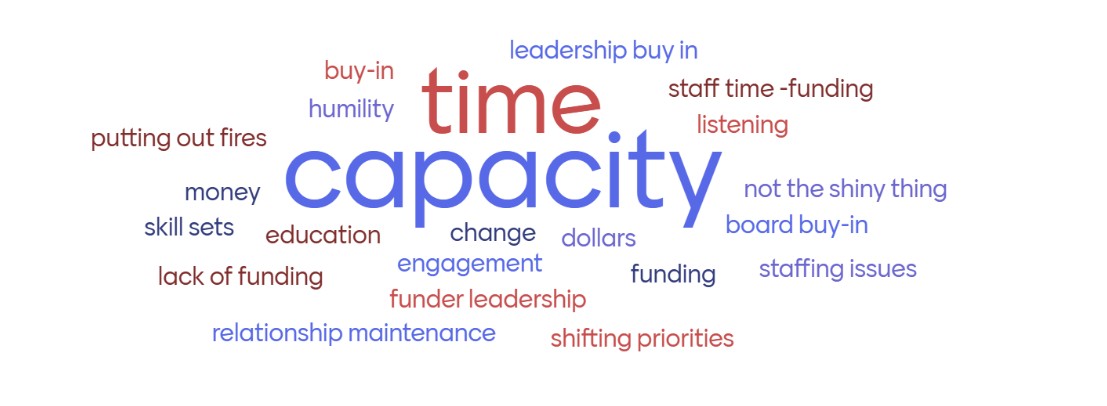
This was a useful discussion where participants discussed these challenges and potential solutions as well as made connections with others doing similar work, ultimately to help find the best ways to move this knowledge translation piece into practice.
You can learn more about Making it Work and view all the knowledge translation HERE.
Written by Edi Young and Leanne Zubowski