
As already established in this series of articles, community-based research (CBR) is a way of doing research with communities, not just about them. It brings together people with lived experience, service providers, and researchers to ask questions and find answers that matter to the community. This article provides an overview of the different phases of CBR, from identifying research needs to outcomes & impacts. Even though we don’t go into deep detail about each phase, this big-picture view can help people understand how each phase works and why they are important.
It’s important to know these 9 phases aren’t strict steps that must be followed in a set order. They’re a general guide to show how the process can unfold over time. In real life, the phases often overlap, repeat, or happen in a different order depending on the people involved and the community’s needs. We encourage people to explore other ways of looking at the process or even come up with their own version that makes the most sense to them. The goal is to help make stronger connections, better learning, and more meaningful use of community-based research in practice.
The 9 Phases of CBR
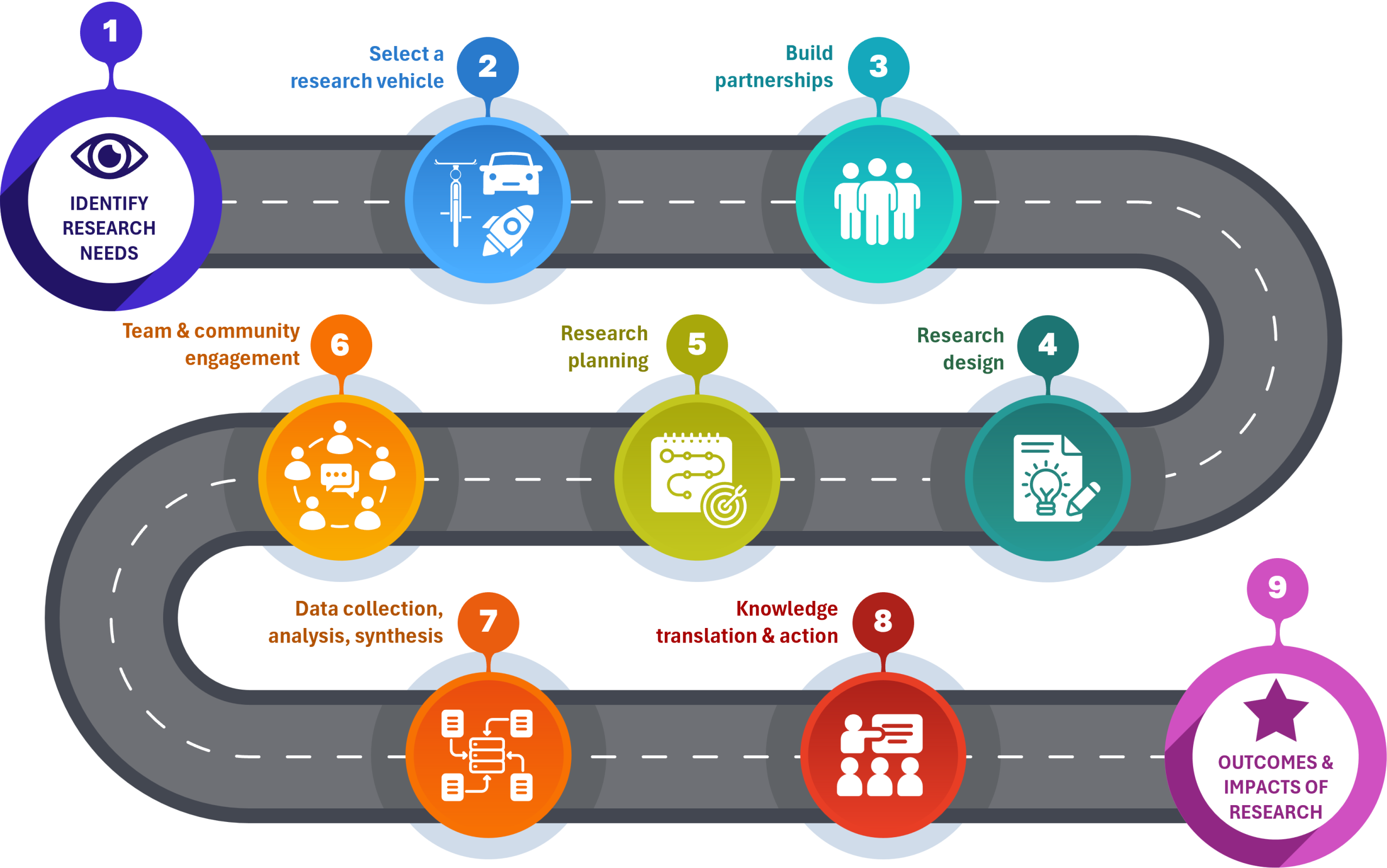
1. Identify research needs
The first step in community-based research is determining what needs to be studied. This involves identifying questions whose answers can inform action, deepen understanding, solve a problem, or raise awareness. These questions should emerge from the real-world experiences, concerns, and priorities of the community.
To identify what’s already known and where knowledge gaps exist, a review of existing literature is essential. Equally important is engaging the community in discussions or consultations to gather input on what matters most to them. Combining these the sources of academic knowledge and lived experience helps clarify the focus of the research and prioritize what issues need to be explored.
2. Select a research vehicle
Think of research as a journey to find answers, and to go on that journey, you need the right vehicle to get you there. The kind of vehicle you choose depends on how far you need to go and how rugged the terrain is. Sometimes, the research questions are close to the surface and the path is clear. In these cases, a bicycle might be all you need. It’s simple, flexible, and powered by community effort. This kind of research might involve a few web searches, conversations with community members, or drawing on existing reports. It’s fast, accessible, and low-cost, but it still gets you somewhere meaningful and insightful.
Other times, your destination is much farther, the terrain is uncertain, or the answers are hidden deep in complex systems. In those cases, you might need to build a rocket ship. That means assembling a team of specialists, using rigorous and sometimes technical research methods, securing funding, and navigating ethics approvals. It’s resource-intensive but necessary when the questions are big, sensitive, or require precision and credibility.
Most research falls somewhere in between; a motorbike, a car, or even a canoe, balancing complexity, speed, collaboration, accessibility, skill, and capacity. The key is to match your vehicle to the journey ahead. Don’t overbuild for a short trip, and don’t underprepare for a long one.
3. Build partnerships
Research about a community of people should be conducted in that community and directly involve them since the research is intended to benefit them. Ideally, community members are not just participants and are actively included in identifying research needs, what will work best in doing in the research, its design, and how the information can be translated into community-specific knowledge.
Building relationships is crucial to successful research because trust, respect, and mutual understanding create a foundation for open communication and meaningful engagement, and partnerships go even further because they foster shared ownership, co-learning, and a deeper commitment to acting on the research findings together. Relationships and partnerships are at the heart of community-based research.
4. Research design
The next phase is to design the overall approach to answering the questions, how you’ll go about uncovering the information and insight being sought after. This includes selecting research methods that best fit what needs to be explored, the type of knowledge being sought, and the context in which the research will take place.
The design phase is where you decide how data will be collected, from whom, and using what tools or techniques such as interviews, focus groups, surveys, observation, or creative methods. In community-based research, it’s essential that these decisions are shaped in collaboration with partners, so that the methods are culturally relevant, ethical, and grounded in lived experience. The research design becomes the blueprint for the project, laying out the methodological direction before moving into the logistical details of planning, which follows in the next phase.
5. Research planning
After the research design is in place, the planning phase maps out the practical steps needed to bring it to life. This means putting on your business and operations hat to ensure that everything required to conduct the research is accounted for. It involves detailing timelines, roles, responsibilities, permissions, budgets, and logistics, as well as assessing and gathering resources like staffing, space, technology, incentives, or transportation.
Research planning also includes preparing for ethics submissions, community protocols, training needs, and communication strategies. The goal is to make the process as smooth as possible by creating a clear, shared roadmap that guides everyone involved. A well-planned research process instills confidence, supports accountability, and helps ensure the work stays on track.
6. Team & community engagement
With the research plan in place, it’s time to begin carrying it out while staying flexible to real-world needs. This phase focuses on actively engaging the research team and the broader community, which might include people with lived and living experience, service providers, academics, and community members. It involves inviting participation, hosting meetings, and creating welcoming, safe, and accessible spaces both physical and relational where people feel respected and heard.
Strong communication is key: keep people updated, check in often, and be prepared to adapt the plan or design if community needs, capacity, or priorities shift. This is where the phrase “meet people where they’re at” comes to life, not just geographically, but in terms of readiness, comfort, and access. Throughout, aim to support capacity building and capacity bridging. Engagement is about making space for everyone to learn from one another, contribute meaningfully, and grow together in the process.
7. Data collection, analysis, synthesis
Using the selected research methods the process of collecting, analyzing, and making sense of data is not just a technical process, it’s a collaborative effort rooted in shared “meaning-making”. This phase is about gathering evidence that depicts the realities, experiences, and knowledge of the community. It’s about posing the research questions in a relatable way to a community and seeing what the responses are.
DATA COLLECTION: involves gathering information using the methods chosen during the research design phase—such as interviews, surveys, focus groups, storytelling, or visual tools. It’s important to create safe, respectful spaces where people feel comfortable sharing, and to follow ethical and culturally appropriate practices throughout.
DATA ANALYSIS: is the process of organizing and examining the data to identify patterns, themes, or trends. In CBR, analysis often includes both researchers and community partners, valuing lived experience alongside academic or technical expertise. This collaborative approach helps ensure the interpretation is grounded and relevant.
DATA SYNTHESIS: goes a step further by connecting the dots to bring together findings in a way that tells a clear and meaningful story. It’s where individual data points become collective insight, shaping the narrative that will guide the next phases of knowledge translation and action.
8. Knowledge translation & action
After collecting and making sense of the data, the next step is to share what was discovered (the research findings) with the people and communities who need it most. In community-based research, this means going beyond academic reports. Findings should be shared in ways that are understandable, accessible, and relevant, especially for community members who were involved or who stand to benefit from the knowledge.
Effective knowledge translation includes using different formats like plain language summaries, visuals, community events, infographics, or storytelling and choosing channels that reach a range of audiences, from grassroots organizations to policymakers. The goal is not only to inform but to spark dialogue, reflection, and decision-making.
Reflection and validation are key steps in this phase, too. Community members and partners should have the opportunity to make sense of the findings together, confirm their accuracy, and discuss what the results mean in specific community contexts.
Most importantly, this phase is about moving from knowledge to action. Whether it’s influencing programs, shifting policies, sparking advocacy, or guiding future research, the knowledge created through CBR should contribute to positive, community-led change.
9. Outcomes & impacts of research
The final phase focuses on understanding what changed because of the research, both in the short term and over time. In community-based research, it’s important to look beyond academic outputs and ask: What difference did the research make for the community, the partners, and the systems involved?
OUTCOMES: are the more immediate results such as increased knowledge, new skills, strengthened relationships, or changes in programs or practices.
IMPACTS: refer to the longer-term, often broader effects like shifts in policy, improved health outcomes, or sustained community empowerment.
This phase may involve formal evaluation or informal reflection and should include the voices of community partners in assessing what worked, what changed, and what still needs attention. Highlighting outcomes and impacts helps close the research loop and reinforces the value of identifying community-driven needs.
Summary
Community-based research often begins by recognizing a need or question that matters to the community. From there, people work together to decide how best to explore that need, sometimes through simple storytelling, other times through more formal research methods. Building strong relationships and trust is key, as is designing and planning the research in a way that reflects shared values and goals. Throughout the process, it’s important to stay engaged with both the research team and the wider community. When it’s time to gather and make sense of the information, the analysis is done with care and context in mind. What’s learned is then shared in meaningful ways that lead to action, advocacy, or deeper understanding. In the end, the most important measure of success is the impact the research has on the community and the people it was meant to serve.
Written by Monte Strong