
PAN’s partnership with Dr. Mark Gilbert of the BCCDC. This project was funded by UBC’s Community-University Engagement Support (CUES) Fund.
Why was this project needed?
Increasing testing for sexually transmitted and blood borne infections (STBBI) is a necessary response to rising STBBI rates in British Columbia and new testing options are readily becoming available that allow testing to be done outside of clinic settings.
In 2020, PAN released an HIV testing needs assessment which recommended community service providers such as peers (people with lived and living experience) or other staff in community-based organizations (CBOs) be supported to take a greater role in testing to reduce demands on clinical services. Community service providers are often the first line of contact with the health system for many people needing STBBI testing who are challenged accessing healthcare traditional services (e.g., for fear of judgement or stigma such as sexual and gender minority people or people with lived experience of substance use). Some aspects of the testing process require healthcare provider involvement (e.g., ordering appropriate treatment). However, the roles that could be played by community health workers as part of the STBBI testing process are not defined, nor are the system resources and infrastructure required to support these roles.
In the Testing Guidance Project (TGP), PAN led a community consultation to answer these questions that included facilitated events and development of a guiding framework to be shared with provincial STBBI testing practice leads and decision-makers, alongside CBOs.
How was this project completed?
The Testing Guidance Project (TGP) was a collaboration between PAN and the University of British Columbia (UBC), with support from the UBC Community-University Engagement Support (CUES) Fund.
The project began with the establishment of a Community Advisory Committee (CAC), which helped identify key priorities and develop questions to guide community consultations. PAN and UBC then engaged more than 80 individuals from across British Columbia, including people with lived and/or living experience(s), community-based organizations, healthcare providers, researchers, and health authority representatives. Through these consultations, participants shared their experiences, identified barriers and opportunities, and highlighted promising practices for strengthening community-based STBBI testing and linkage to care.
To learn more about the consultation process, please review:
The information gathered through consultations informed the development of a community-informed guidance framework. A consensus-building and review process followed, with the draft framework shared with the CAC, participating organizations, and external reviewers to ensure the findings and recommendations reflected the diverse perspectives and experiences shared throughout the project.
The project has now been completed, with the final framework and accompanying community-accessible resources developed. While the full framework is not yet publicly available, PAN is continuing to share the findings and explore opportunities to support their use in practice.
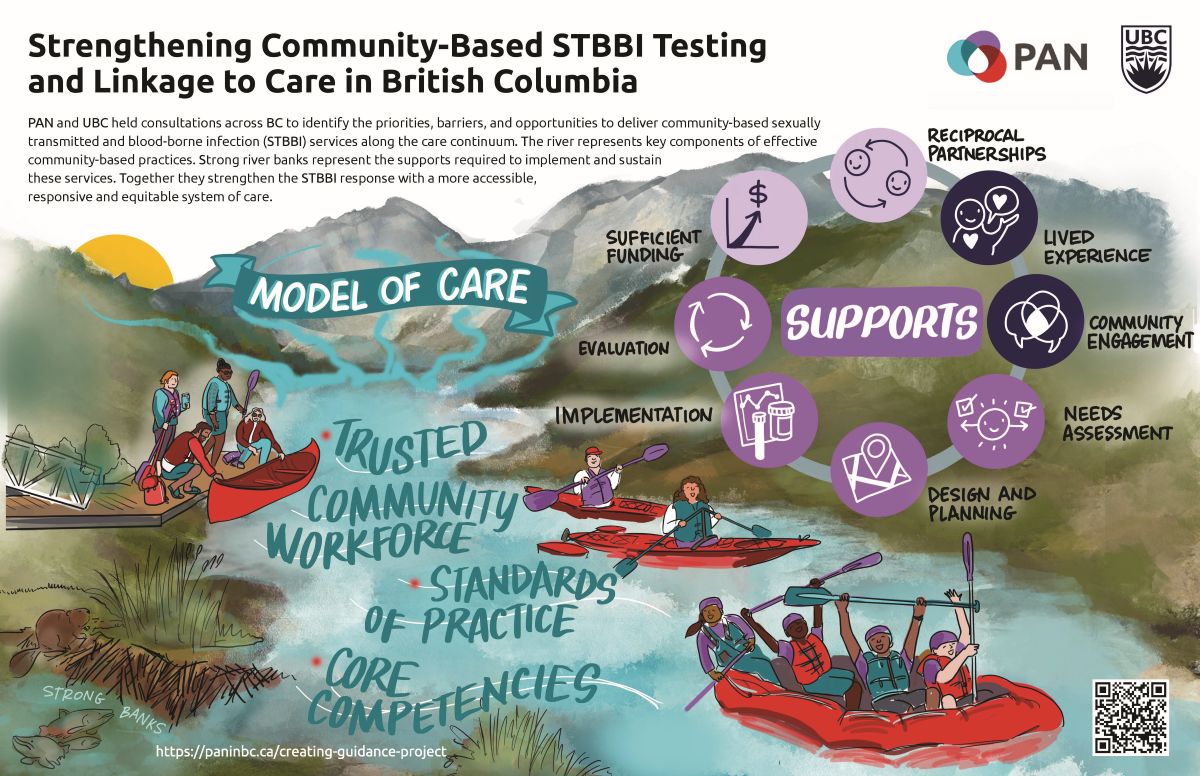
October 2026: Illustrated Summary Document Available Here
The full Framework to Support and Strengthen Community-Based STBBI Testing and Linkage to Care in BC will be available soon.
Outcomes of the Testing Guidance Project:
The primary outcome of the project was the development of the Framework to Support and Strengthen Community-Based STBBI Testing and Linkage to Care in British Columbia. Designed to inform health system decision-making, service planning, and future investments, the framework brings together community knowledge, lived and living experience, and research evidence to identify the conditions needed to strengthen community-based STBBI testing and linkage to care.
The framework identifies standards of practice, core competencies for peers and community-based workers, and recommendations for the resources, relationships, and infrastructure needed to support sustainable, culturally responsive, and accessible services. It recognizes the critical role of trust, community leadership, and meaningful engagement of people with lived and/or living experience(s) in improving access to testing, treatment, and ongoing care.
An additional outcome was the development of an illustrated, community-accessible resource and poster that communicate the framework’s key findings and recommendations through plain language and engaging visuals. These resources help make the project’s findings accessible to community-based organizations, peers, service providers, and others who may benefit from the guidance.
Although the project deliverables are complete, knowledge dissemination will continue through provincial and regional gatherings, training opportunities, and engagement with community and health system partners. Findings have been shared at PAN’s provincial gathering in Richmond, with further dissemination planned through a Fraser Health Authority regional training event in December 2026 and a presentation at the Canadian Association for HIV Research (CAHR) conference in 2027.
Beyond these immediate outcomes, the framework provides a foundation for future work to strengthen community-based STBBI testing across BC. This could include informing new testing initiatives, supporting the development of training opportunities for peers and community-based providers, and providing evidence-informed guidance to advocate for sufficient and sustainable resources.
The project has also strengthened relationships between community organizations, researchers, and public health partners, including Dr. Mark Gilbert and colleagues at the BC Centre for Disease Control. These connections create opportunities for the findings to inform future policy and programming decisions, including the development of community-focused resources to support new STBBI testing approaches.
Together, the completed framework, accessible resources, and ongoing knowledge dissemination activities contribute to a stronger connection between academic research, community knowledge, and public health practice, with the shared goal of improving equitable access to STBBI testing and linkage to care across British Columbia.
Still have questions?
For more information please contact Simon Goff at [email protected] or Emily Taylor-Lariviere at [email protected]