
 International Overdose Awareness Day has been running for almost 20 years and is a global event held on 31st August, aiming to raise awareness of overdose and reduce the stigma of a drug-related death. It also acknowledges the grief felt by families and friends remembering those who have died or had a permanent injury as a result of drug overdose. Its simple, painful message is that overdose death is preventable, and that thousands of people die each year from drug overdose, from all walks of life. The call this year is to remember, and to act.
We are all acutely aware of the devastating impact of our overdose epidemic in BC, which despite the declaration as public health emergency in 2016 is now more deadly than ever. Even the release in March this year of new clinical guidance, including safe supply to mitigate risk for people during COVID-19, has not stemmed the tide – due in part to an increasingly toxic supply, and barriers in accessing “pandemic prescriptions”. This month an additional $10.5 million in funding was announced to support prevention and treatment services, but there is frustration in some circles with the provincial response that has led key advocates to pull out of consultations. It should challenge everyone that 65% of people dying of overdose are dying alone, even in communities where there are well established OPS, so more needs to be done.
On the national stage Canada’s Chief Health Officer Teresa Tam has just called for a safer supply of drugs and building more supervised consumption sites, and added that all approaches must be considered, including “moving toward a societal discussion on decriminalization.” She joins a number of officials and groups have called on the federal government to decriminalize hard drugs to address this opioid crisis, including the Canadian Association of Chiefs of Police, BC Premier John Horgan, as well as medical health officers in British Columbia, Toronto and Montreal. Pressure is building, and now is a time to continue to act.
Since 2016 at PAN, drug policy and responding to the overdose crisis has become a key part of our work and gatherings. Also, based on our early community needs assessment, we created the following online resources: Substance Use News; Harm Reduction Instead of Criminalization; Overdose Prevention, Care and Recovery; Peer Voices and Resources; Harm Reduction; Grief, Loss and Resilience; The Fight Against Stigma; Treatment Resources and Care; Reports, Recommendations, and Research.
Recent educational (and inspirational!) highlights have been Guy Felicella’s webinar and Dr. Christy Sutherland’s AGM keynote on a safer drug supply and the question of decriminalization – two crucial foundations for overdose prevention.
Since COVID-19 struck, PAN has been working hard to support our members, and has incorporated our network’s feedback in a letter to Ministers Dix and Farnworth calling for universal access to safe supply and urging the province to revisit its position on decriminalization and to implement Dr. Henry’s recommendations. We recognize these calls are shared by many other agencies, community-based organizations and peer networks – who have been leading the charge for years.
In addition our member organizations requested that we work to collect information about their experiences with the roll-out of safe supply over time. We have just completed our first collection of stories about success, challenges, and impacts – to help shape our advocacy and capacity building work. This month, Cheryl Dowden (ANKORS) and Evin Jones (PAN) met with Minister Darcy (MMHA) concerning the key messages (below) and she expressed interest in meeting again to examine the results of our survey.
A Time to Act
There are 6 key messages that we have been promoting concerning safe supply and decriminalization – actions that we believe will prevent overdoses and save lives:
- We need to meet people where they are at and provide them with the drugs they need to provide real choice and separate them from a toxic supply. Treatment options need to resemble what people are seeking in the illicit market. There is lots of evidence based data both locally and internationally to show the efficacy of providing more options. We also need safe stimulants such as regulated cocaine. At our ‘health care’ centers (OPS’s, inhalation services) we are still inviting people in the door to use poisonous drugs, when we should be providing them with safe medicine. Low barrier solutions (such as a domestic supply of heroin and its supply) are already being explored, so why not fund and expand them?
- We need to expand the base of prescribers; and prescribers and would-be prescribers need to be more supported in this work. This is a longstanding issue that requires significant investment in addiction training and to expand the network of prescribers. We would like to see the creation of a true community of practice. Moreover we need clear leadership and messaging to prescribers that supports them in increasing their risk tolerance. A recent UBC study shows that opioids used to treat addiction are seldom in the system of overdose fatalities, which should make doctors feel more comfortable in prescribing them to drug users.
- PAN members, community-based organizations and peer networks need to be funded for low-barrier work and recognized as essential partners – independent on location. We need to have OPS, drug checking, peers for peer navigation and harm reduction work – particularly with a view to smaller communities/ rural contexts, etc. – this needs to be properly funded and sustainably funded, rather than patchwork and insufficient. Demands and strains on PAN members have only grown great due to COVID-19. Outreach and peers are needed and, in many cases, this best sits with community organizations.
- We need to uncouple safe supply from COVID-19 and make it central to the province’s overdose emergency response. This can be done with a public health order to support ongoing access to safer supply post-COVID 19– and provide assurance to physicians to continue to prescribe without having to consider federal drug laws.
- Need a comprehensive provincial strategy for overdose response with real targets and accountabilities built in. Here we could consider the success of STOP HIV/AIDS and see how it can model the way.
- DECRIMINALIZATION: We are urging the Province to immediately revisit its initial reaction and instead implement Dr. Bonnie Henry’s simple but effective recommendations. As mentioned at the start, there is growing movement in the hallways of power acknowledging that people should not be labelled as criminals for simple possession, as this is a chronic relapsing health problem. Premier John Horgan wrote the federal government for “a national plan to decriminalize the possession of controlled substances for personal use.” It’s an “essential strategy” to save lives, he said. But if so, why has his government failed to act on Henry’s straightforward life-saving decriminalization plan?
A Time to Remember
The impacts of COVID-19 on people who use drugs are becoming terribly clear – with 170 deaths in May, that single month exceeded all of the lives lost due to COVID-19 since the pandemic began in BC. The situation got worse in June, and we expect July will not be any better.
But statistics mean nothing in comparison to friends and colleagues, partners and children, who have been lost to this health crisis. Many of these deaths were preventable, if there was political will and courage, and so many lives and communities have been affected – especially from a worldwide perspective.
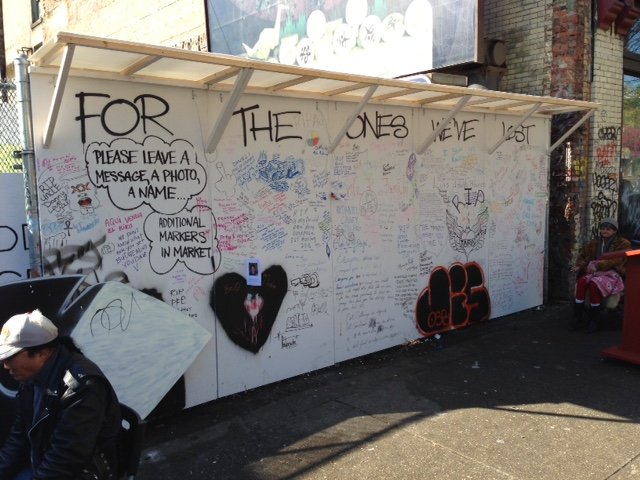
People grieve in different ways, remember and celebrate in different ways. There are makeshift memorials, and graffiti walls.
From the international campaign, the silver badge, purple wristband and purple lanyard are symbols of awareness of overdose and its effects. Wearing these signifies the loss of someone cherished, or demonstrate support to those undergoing grief. It sends out a message that every person’s life is valuable and that stigmatizing people who use drugs needs to stop.
Resources
From the International Overdose Awareness Day website:
Post a Tribute – to a loved one who has passed away from an overdose.
Host or Attend an Activity – a powerful way to stand together to remember people who have lost their lives to overdose.
Find an Activity in Canada – there are registered events all across our province.
Promotional Resources – materials to share within your community to help prevent overdose.

Questions? Feedback? Get in touch!
Simon Goff, Executive Assistant and Collective Impact Coordinator, [email protected]
Photo credit: https://globalnews.ca/news/3371735/memorial-wall-for-overdose-victims-erected-on-dtes/