
Public Knowledge Summaries provide ongoing and emerging information on BC Centre for Disease Control analytical findings. This information can be freely shared among your colleagues, contacts, and the general public.
| TOPIC: | Estimated impact of the provincial take-home naloxone program on preventing illegal drug-related deaths in BC, 2012-2016 |
| DATE OF RELEASE: | April 18, 2018 |
| ANALYSIS LEAD: | Dr. Mike Irvine, BC Centre for Disease Control and Institute of Applied Mathematics, UBC |
| WEBSITE URL: | http://www.bccdc.ca/health-professionals/clinical-resources/harm-reduction/overdose-data-reports |
The British Columbia Centre for Disease Control (BCCDC), in partnership with the Institute of Applied Mathematics at the University of British Columbia (UBC), has developed a mathematical model that is used to estimate the impact of different interventions on preventing overdose deaths in B.C. Several data sources were used in the estimation, including:
- provincial data for opioid-related deaths;
- ambulance-attended overdoses;
- number of people accessing opioid agonist therapy;
- estimates of the number of people who use illicit drugs in BC; and,
- other research data.
The time period for the analysis was January 1, 2012 to October 31 2016, mostly because this time frame was prior to the start of other interventions, such as overdose prevention sites.
The model shows that increasing the distribution of Take Home Naloxone (THN) kits in B.C. is an effective public health intervention to prevent overdose deaths:
- For every 10 THN kits used, one overdose death was estimated to have been prevented.
- For every 65 THN kit distributed, one overdose death was estimated to have been prevented.
In the first 10 months of 2016, the provincial THN program, in partnership with regional health authorities, ramped up naloxone distribution, which prevented an estimated 226 overdose deaths in B.C. In other words, 26% of all possible overdose-related deaths in B.C. were prevented by the THN program during this time period.
Between January 2012 and October 2016, the model estimated that the THN kit program prevented 300 illicit drug overdose-related deaths, including 155 fentanyl-related overdose deaths.
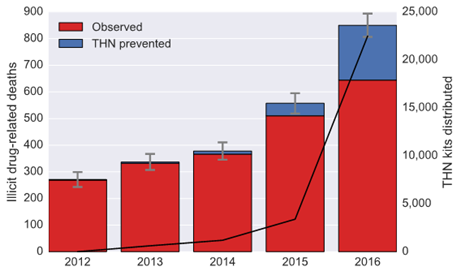
Figure 1: Estimated impact of Take Home Naloxone (THN) Jan 2012 – Oct 2016 on overdose-related deaths.
o Red = Observed number of illicit drug-related deaths
o Blue = deaths prevented by THN program
o Black = THN kits distributed.
The next phase of this modeling analysis will include other data sources, and collaboration with other provincial agencies. With additional data, the impact of other overdose-related interventions, including overdose prevention sites, opioid agonist therapy use and access to prescription grade opioids, can be assessed.
The results of this first phase of the modeling project were published in The Lancet Public Health on April 17, 2018, which can be found at:http://www.thelancet.com/journals/lanpub/article/PIIS2468-2667(18)30044-6/fulltext.
To find out more about B.C.’s Take Home Naloxone program, visit: Toward the Heart’s Naloxone page.
For more details on ongoing BCCDC data analysis and surveillance, as well as the Provincial Overdose Interactive Dashboard, visit: http://www.bccdc.ca/health-professionals/clinical-resources/harm-reduction/overdose-data-reports